Unhinged Guide to Japan - Pt. 1
How nightlife in Osaka taught me the rough social dynamics in Japan
The first part of this unhinged guide is about people, not temples. Feelings, stories, and a bit of late‑night research on why social situations in Japan feel so wildly different from Western Europe. How I travelled, who I met, how it all messed with my expectations on dating, friendships, and paid sex. It's about the things I only realized afterward and what I would do differently the next time.
Should I travel to Japan?
This is one of the most asked questions I received, coming back and talking to friends. I always answered with a counter question: Do you plan to travel alone?
Travelling solo has its charm, sure. Same as clubbing alone, which I do way too often. You move on your own schedule. You do not have to wait for anybody and are wide open for new faces as well as bad decisions. But looking back at Japan, I am ridiculously thankful that I almost always had someone with me. Be it a friend or a lover. Someone I trusted enough to dump my confusion on in this totally different culture and say, “Did you see that too, or am I losing my mind?”
Rec. 1: Have someone you can share your impressions with. Best in person; alternatively, via call or text.
Because, oh boy, was it different there. And voicing it helps combat the isolating feeling that, for sure, will appear sooner or later in such a vastly distinct environment. A platonic friend is ideal for that, but what about seeking romantic company?
Dating is just another slice of this whole mess, but it is the most intense one. How people communicate, flirt, touch, or interact bleeds into every other interaction.
Re-adjusting
I would call myself a man with a healthy level of confidence. Not arrogance, just the basic functional kind that gets you through a room on a positive note. I have no problem walking up to someone on the street or in a café. But in Japan, that impulse immediately disappeared. Just from the initial impression of the culture being too different. No matter if it was outside during the day, or in a dimly lit club.
Rec. 2: Outside of Tokyo, the level of English is, on average, very low. Be prepared to use your translator app a lot and maybe even memorize some basic daily life Japanese sentences.
There are dozens of restaurants with only Japanese menus, and speaking a different language causes negative reactions with some servers. Same with voicing romantic interest publicly. Most girls simply do not know how to respond. The Language barrier adding to their hesitation, but also because of Japanese men. Those are described across the board as shy to the point of near-paralysis around women they do not already know.
As a result, the whole dynamic became weird. Most notably is the fact that dating became much more transactional. Buying companionship, be it simply as entertainment or a friendship replacement, up to proper prostitution became widely present. Officially forbidden, practically everywhere. It’s common knowledge and quietly accepted by everyone. But I only really understood that once I got to Osaka.
Full Osaka Google Maps List: Clubnacht - Osaka Guide
First night in Osaka
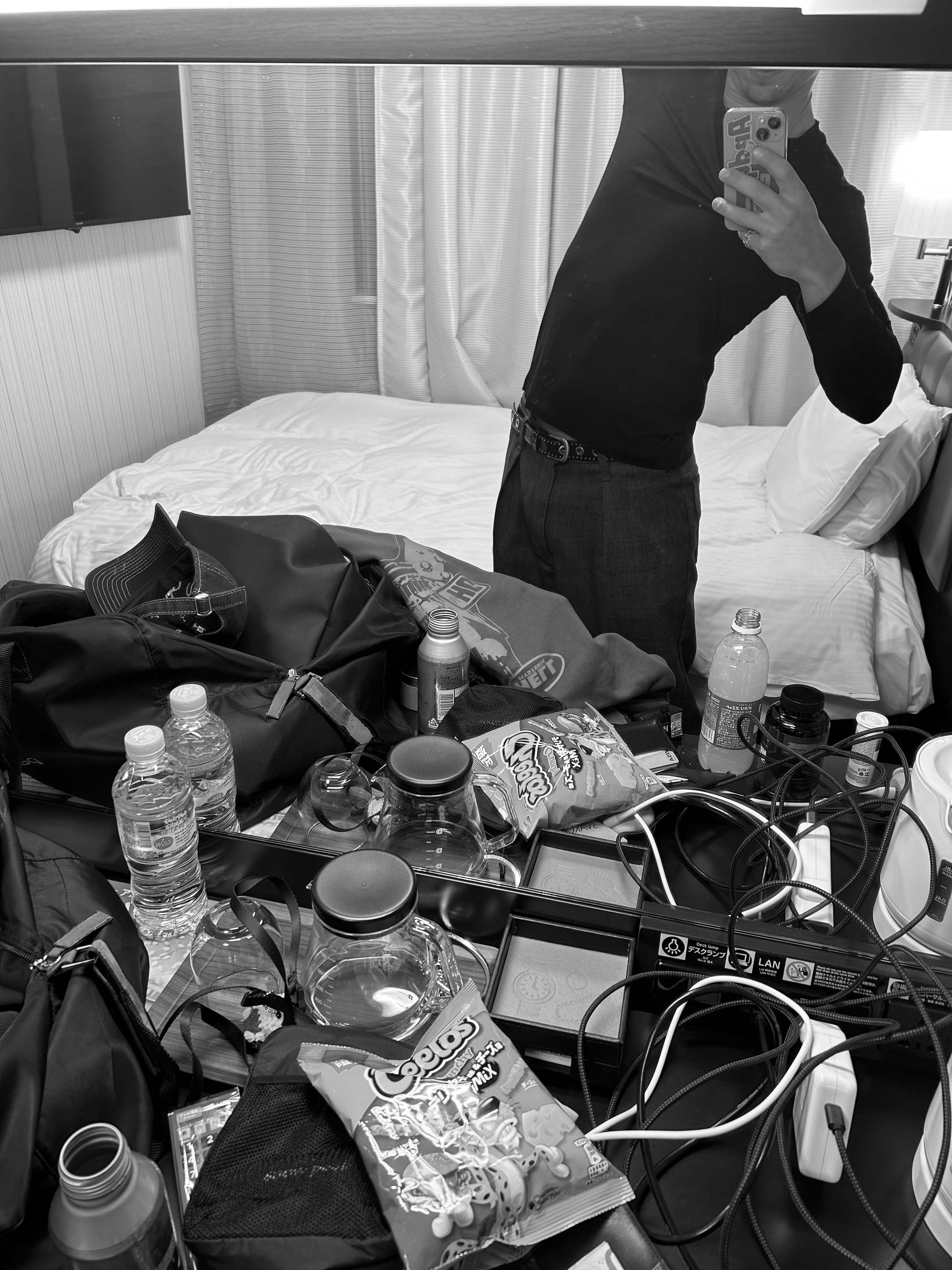
With a friend I knew from university, who by chance happened to be in Osaka, we decided to go out in Namba. The main nightlife district. I had originally planned to stay only one night in the city, and since the chance of us pulling an all-nighter was relatively high, I booked the simplest possible hotel with only one priority: stay central. The hotel turned out to be by the APA chain, one of those you find by the dozen in every Japanese city. A tower with over 30 floors of identical rooms. Boring and functional. The whole building seemed engineered for maximum human storage, to the point where they had rooms without windows. Like the one I had booked.
The moment I walked in, I had a sudden and sincere urge to kill myself. Three square meters with no natural light will do that to a person. I am fairly certain most prison cells are cozier. I left within minutes, bought drinks from the convenience store downstairs, and went up to the roof to watch the sunset.
Rec. 3: Avoid APA hotels at all costs. They will disproportionally negatively affect your traveling experience.
Either you spend more on a better hotel as the simplest solution, or you browse for listings apart from booking or Airbnb. What's very prominent in Asia is Agoda, often with extra vouchers and better deals than Booking.com. Facebook Marketplace can be used for a longer stay, again with local alternatives like Kaguaruoo or Dash Living. Sometimes it’s cheaper to book on site than through an online portal, but that only works if there are no conferences and it's quite in town. For short stays, even love hotels can be a cheaper and way more comfortable alternative, but more on that in the next part of this guide.
The Beginning
Once my friend arrived, we left and decided to freestyle the night. Before we did, we both took some anti-hangover medication, the kind they sell openly in every konbini store here.
Rec. 4: Japan is a heavy-drinking society, and they have engineered the pharmacology to counter the side effects. Use it! Trust it! You will need it.

Coming from European bar culture, it turned out to be almost impossible to find something that felt even remotely familiar. The buildings we kept entering had dozens of bars stacked on top of each other across multiple floors. Each bar was the size of a studio apartment that someone didn’t furnish for style, but to be as strangely unique as possible. Twenty to thirty square meters. Space for five to ten people, each with a different theme: dive bar, a war-themed bar with fake rifles screwed to the walls, an acid bar that looked like someone had vomited Alice in Wonderland onto the interior decorator's brief. Everything was there, but nothing seemed to work for us.
Rec. 6: Only because something is “super local” doesn’t mean it will be a good experience for you as a tourist.
Every single one of them—and we tried around thirty—felt like we had walked into a private flat without being invited. Especially when Japanese people were already inside, the body language was immediate and clear: you are in the wrong place. Which, on some level, is understandable. We did not speak Japanese, and we could not hold a conversation. We would have just sat there radiating foreign energy. On the other hand, those were public bars, and we were paying customers. Being silently but firmly shown the door over and over again wears you down in a specific, grinding way.
In the ones we were accepted, we noticed that the drinks were weirdly weak. They were cheap at around 500 to 1000 yen, but the highballs tasted as if someone had only shown a bottle of whisky to a glass of soda from a respectful distance. A strong zero from the nearest 7-Eleven hits harder than five of those combined.
Rec. 7: No matter which drink you’ll get at a bar. It will never have the same punch as a strong zero.
So after a while, this was exactly what we did. We surrendered from the first bar building, walked over to the closest konbini, and drowned a couple of strong zeros. If it was to recalibrate after our experience, or to forget the strange bars we had just spent two hours inside - I can't tell anymore.
What stood out however was, that by this point of the night (around 2 am), the streets were filling with well-dressed women in schoolgirl outfits standing in front of certain bars. And yet once again, as foreigners, we were functionally invisible. Nobody approached us, nobody held eye contact, nobody seemed to see us at all.
Taking matters into our own hands
Blame my drunk and horny self, or simply blame curiosity. At some point, we started talking to one of the hostesses dressed in a seifuku standing outside a bar. With her colleague, my friend, and some combination of broken English, we ended up inside.
The bar was "diamond-inspired," which meant LEDs set to a cold bluish white and the general atmosphere of a generic shisha lounge that had been told it was upscale (it wasn’t). The girls poured our drinks. Then they sat down. And then we all stared at each other.
Rec. 8: If you decide to go to a host(ess) bar, at least make sure they speak english before going in.
Our Hostesses did not speak English. Not a sentence, not a functional syllable. We tried hands and feet. We tried miming. We tried Google Translate, which, under these conditions, made the situation even more comical. In the end, we had achieved absolutely zero communication. After one drink, we settled the tab and left.
After a while, we decided to try the concept one more time. This time, for a different reason: we just wanted to feel welcome after the devastating past few hours. This led us to a bar that had both a male and a female host. A slight upgrade: the male host spoke basic English, enough to actually exchange a few real sentences. I played a few rounds of darts with him while my friend talked to the girl. We were still the only guests. Paying for the company of strangers still felt strange. But at least there was something that resembled a conversation.


Blame my drunk and horny self, or simply blame curiosity. At some point, we started talking to one of the hostesses dressed in a seifuku standing outside a bar. With her colleague, my friend, and some combination of broken English, we ended up inside.
The bar was "diamond-inspired," which meant LEDs set to a cold bluish white and the general atmosphere of a generic shisha lounge that had been told it was upscale (it wasn’t). The girls poured our drinks. Then they sat down. And then we all stared at each other.
Rec. 8: If you decide to go to a host(ess) bar, at least make sure they speak english before going in.
Our Hostesses did not speak English. Not a sentence, not a functional syllable. We tried hands and feet. We tried miming. We tried Google Translate, which, under these conditions, made the situation even more comical. In the end, we had achieved absolutely zero communication. After one drink, we settled the tab and left.
After a while, we decided to try the concept one more time. This time, for a different reason: we just wanted to feel welcome after the devastating past few hours. This led us to a bar that had both a male and a female host. A slight upgrade: the male host spoke basic English, enough to actually exchange a few real sentences. I played a few rounds of darts with him while my friend talked to the girl. We were still the only guests. Paying for the company of strangers still felt strange. But at least there was something that resembled a conversation.
After that we drank another strong zero on the street and, fully drunk, went looking for one final place to end the night. It was somewhere between four and five in the morning. Many bars were still technically open, but finding one that was not either completely empty or silently hostile to foreigners was another matter entirely. It was disorienting, stepping into empty bars at that hour where a bartender stood waiting behind the counter like a man who had accepted his fate, while in other places the door was wide open, the lights still on, and the staff lay passed out and asleep across their own furniture.
We eventually found a bar where we mixed with some Osaka locals. The conversations were basic— the kind that happen when everyone is too tired and too drunk to bother with full sentences. We finished a few drinks, smoked too many cigs, and watched the locals sing karaoke. I held it together. My friend did not. I carried him home.
Of course, I was not exactly untouched by any of this. I overslept in my windowless room, woke up with no idea whether it was morning or afternoon, and in a moment of either stubbornness or masochism decided to extend my stay by another night. And for what reason? To go out again. This time: Umeda, the second and supposedly more local nightlife district.
A Second Try
If we had only taken our own advice, that more local does not necessarily leads to a better experience. Because this time the rejections did not start with the bars, but we were already turned away from several restaurants and izakayas just looking for food. It was not that they were full. They simply did not want non-Japanese-speaking customers, and they made that clear without using a single word. The izakaya we finally found did not have an English menu, the communication was rough throughout, and when we left I tried asking one of the staff for a recommendation for a nearby bar. Nobody would give us a straight answer, despite the street being lined shoulder to shoulder with options.
Umeda felt even more like host-bar territory than Namba had. The sheer number of polished-looking young men and women in expensive outfits walking purposefully up and down in front of certain doorways was almost impressive in scale. But after the previous night, we had made a decision: we were not paying for their companionship again.

A Cultural Observation
Walking the area, a pattern emerged. Groups of five to ten people in business attire would file out of an izakaya and disappear into a nearby karaoke venue. Sometimes the group split at the exit, and the outliers drifted (alone) toward the host places.
Outside the connections formed at work, there seemed to be almost no culture of meeting people you did not already know. Karaoke here happens in private locked cabins—no mingling, no strangers, no accidental conversations. The kind of bar where different social circles collide and some unexpected friendships start seemed to barely exist. And those people who were looking for more than their existing social circles found it elsewhere… at a price.
Rec. 9: Know the difference between regular pubs, snack bars, host clubs, and massage parlors.
Pubs: The baseline social habitat. Four walls, a counter, a bartender, drinks, and a bunch of strangers. You pay for alcohol, not attention. Whatever happens beyond that - conversation, flirting, friendship, disaster - is on you, not on the business model.
Host clubs: A customer, man or woman, pays to sit with an attractive, attentive host or hostess who pours their drinks, listens to them, flatters them, and makes them feel interesting and important for as long as the tab stays open. The product is not sex. The product is the feeling of being wanted. The hosts are trained to blur the line between professional performance and genuine affection until the customer cannot tell which side of it they are standing on—and that ambiguity is not accidental, it is the entire business model. Clubs also actively encourage hosts to stay in contact with customers between visits, sending messages, remembering details, driving return traffic. The hostess who flirts with you remembers your birthday. She is paid to.
Officially, nothing physical happens at the club itself. In practice, some hosts do see clients outside, and those relationships can turn into something else. There is no blanket rule against it. You meet through the club, exchange numbers, and take it from there. Whether anything beyond flattery is on the table depends entirely on the individuals involved, and on how many return visits the customer has racked up.
The women on the customer side carry a particular risk. The clubs run tabs. The tabs grow. A woman who becomes genuinely infatuated with her host starts spending more than she has, because the host makes her feel like money spent on him is money well spent. When the debt gets bad enough, some of those women end up working as hostesses themselves to pay it down. The host who ran up their debt becomes their indirect employer. It is as clean and brutal a trap as anything you would find in a crime novel.

Snack bars: Basically, a living room that accidentally became a business. One small room, a counter, maybe half a dozen seats, and a mama-san who does everything: pours the drinks, keeps the conversation alive, sings a song when the mood is dead, laughs at the same old jokes from the same half-broken salarymen. You pay a small cover, your drinks, and in return you get this low-key, slightly tragic sense of belonging for a few hours.
Host clubs are the industrial-strength version of that. Same idea—buying company—but scaled up, sharpened, and weaponized. Instead of one mama-san and a handful of regulars, you get an army of polished boys or girls who are professionally trained to flirt, remember your favorite drink, and make you feel like the main character while your tab quietly bleeds you out.
Massage parlors: This one sits somewhere between self-care and soft-core confusion. From the outside it sells “relaxation” and “health”. The trick is that the menu is technically clean: oil massage, aroma course, 60 minutes, 90 minutes, whatever. The dirt, if there is any, hides in the price, the wording, and the unspoken understanding. Sexual services are officially banned in Japan, so the industry runs on loopholes. You overpay for something innocent (e.g. a drink, candy, or massage), and everything beyond that happens in a grey zone that is never written down. Half spa, half loophole. The Japanese love plausible deniability, so everyone can pretend nothing happened on the way out.
Clubs: A club is a club, even in Japan. We have checked out two small “underground” techno places—Rake Rake and one other whose name I have already forgotten (Minamisenba area). Both were nearly empty and thick with cigarette smoke. Both places we left quickly.
Rec. 10: Smoking is usually allowed everywhere in Japan. In clubs, in bars, sometimes even in restaurants. The smaller the place, the quicker you'll smell like an ashtray.


Saving Grace
For one last attempt, we went back to the floor-by-floor bar lottery and decided the type of place we hadn’t experienced at that point: a snack bar.
We were particularly lucky, as the women behind the counter could speak some decent English and make us feel welcome. With us sat four women between their mid-twenties and mid-forties, plus two Japanese businessmen in their forties. One of them, barely speaking English, still took it upon himself to entertain the room. He cracked jokes across the language barrier, stood up periodically to sing Japanese karaoke songs, and had drink after drink. The women were friendly but restrained—except for the oldest one. With the help of the bartender, she told us that she was a mother of two, found us both very attractive, and repeated how pretty we were several times over the course of the evening. After two nights of being rejected from bars, restaurants, and a feeling of being invisible to every woman in Osaka, we accepted this gratefully.
The second businessman was something else. When we walked in, he was slumped forward over the bar, head down, barely moving. His hands and face were puffy in the way of someone who has been doing this for years. On his wrist, a Rolex Daytona. A twenty-thousand-dollar watch strapped to a man who was quietly falling apart on a barstool. After a while, he stood up, walked with obvious effort to the toilet, and puked loudly enough that no one in the room could pretend they had not noticed. He came back, sat down, and continued drinking. After a while, he also sang some karaoke. My friend and I exchanged some confused looks. However, no one else batted an eye, and we realised that this was probably the most normal thing.
The bartender did her job well: she translated between English and Japanese, played card games, sang a few songs herself, and kept the conversation moving in all directions. We paid a small charge for it. But for the first time in two nights in Osaka, we felt welcome. The name is @snack_hi_doyama -check them out on instagram and give them a visit if your in Osaka!
After a while, the whole thing started to feel sad in a way that was hard to name exactly. The random wreckage of people stranded at a snack bar at three in the morning, the living-room atmosphere, the heavy drinking, the Rolex soaking in a puddle of whisky. It all pointed toward the same thing: people coming here regularly because there was nowhere else. I exchanged Instagram with the bartender before we left and saw later that she frequently went out to dinner with guests before they all moved over to the bar together. The line between customer and friend was either blurred or had never existed.

An overall feeling
In many ways, Japan has been a pioneer for decades: the technology, the infrastructure, the obsessive civic precision. This trip to Osaka made me realize the dark sides of it, which are often overlooked. Besides the general issues like declining birth rates, productivity collapse, and an aging population, retreating from social life was something I didn’t expect to feel during a vacation. But I did, and the concepts like host clubs and snack bars that emerged from it hint into how increasingly transactional the world becomes.
It’s not like we are some saints. In the West, we are slowly catching up. People go out less, loneliness metrics climb, and everyone is on their phone at the dinner table. But in Japan, the needle already traveled further. People seemed to operate almost entirely within sealed circles - work, family, university. For everything else, some form of payment is required, be it for the simulation of a connection at a host bar, a rent-a-boyfriend service, or sexual favors.
Those two nights in Osaka were rough. That is the most honest word I have for them. By that point, I had already been in Japan for two weeks, but had moved in tourist-friendly environments the whole time. Shibuya, Shinjuku, central Kyoto. Osaka was the first time the country dropped its curtain and showed me something completely different.
I was glad I had my friend with me. If I had gone into those streets alone I would have been lost in the bad way, the way that stops being interesting and just becomes isolating. The alcohol helped me avoid overthinking every strange situation in real time. Still, thinking back about those days leaves a bitter aftertaste with me.
This is the first part of my unhinged guide to Japan, because it really highlights the different mentality compared to Europe. I hope that my stories can prepare you well and help you avoid some of the mistakes I’ve made. It’s not my goal to portray Osaka as a negative experience, and I’ve talked with people who had a vastly different experience from mine. Some time in the future, I am inclined to go back and give it another try.
In the next parts of the unhinged guide, I will talk about love hotels, drugs, clubbing, dating, and more. Stay subscribed on Instagram @clubnacht